

The “War Memorials Trust” works to protect and conserve all war memorials within the United Kingdom. Paul Goodwin said there are over 200 war memorials in the Stewartry alone in existence and 22 books have been written about them. There are many more memorials in the rest of Galloway.
While Councils are empowered to look after memorials they are not obliged to do so. Ownership of memorials is also sometimes difficult to determine. There are questions too around what kinds of memorials should be defined as war memorials. For example should memorials to people like munitions workers or nurses be regarded as war memorials? Should memorials to personnel killed on air training flights in time of war be included? Paul Goodwin and the Trust take an inclusive view of what constitutes a war memorial.
The main part of the presentation illustrated many examples from the Stewartry. The range of images shown varied from the Battle of Waterloo memorial at New Abbey to the clock in the church tower at Borgue. They demonstrated the great variety of memorials in existence. Examples covered civic public memorials; beautiful stained glass windows; memorial plates on walls of churches and buildings; clock towers; a church communion table; roll of honour books; an original battlefield cross; roll of honour boards from local schools; monuments on private land; monuments at airplane crash sites; a roll of honour board saved from a rubbish skip; hilltop cairns; framed vellum panels. Some of these memorials are located on unusual sites and less accessible sites.
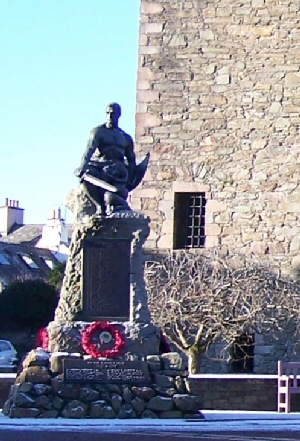
It was fitting that an image of the Kirkcudbright War Memorial was shown, perhaps one of the finest in the Stewartry. It was created by famed sculptor George Henry Paulin, who served in all three services during the first world war. Paulin achieved international distinction for his work which includes the 51st Highland Division memorial, part of the Beaumont Hamel Newfoundland Memorial on the Somme battlefields, as well as the gravestone to Andrew Carnegie near New York.

The speaker also gave a small number of well chosen examples of local men included on some of the memorials to illustrate the personal sacrifice made by so many from the Stewartry.
In this year in which we mark the outbreak of the first world war this was a most relevant and appropriate subject, very well presented and much appreciated by the audience.
Secretary’s note of interest to the above. Although technically not a war memorial, Kirkcudbright Kirkyard has a stone erected by townsmen, in memory of Robert Barbour who was killed at the Battle of Inkerman in 1854.