
St. Cuthbert’s Cemetery, Kirkcudbright (the Kirkyard)
[Revised from the original Galloway News ‘Museum Piece’ (July 2010)]
St. Cuthbert’s Cemetery (the Kirkyard) is of particular historic interest. The older, lower part of the cemetery is known to be the location of the original ‘Kirk of St Cuthbert’, possibly established sometime in the period 680 – 750 when Galloway was part of the Anglian kingdom of Northumbria. The church may have been an important mission centre or minster to spread Christianity in this part of Galloway. The new church was dedicated to the patron saint of Northumbria – St Cuthbert. Although the church has long since gone, its name moved down the hill to the burgh and port which was established sometime after it on the banks of the Dee – Kirkcudbright.
The earliest burial within the bounds of the present cemetery may date as far back as sometime in the 10thcentury. In May 1888, when the cemetery was extended on to the higher ground above the original site,
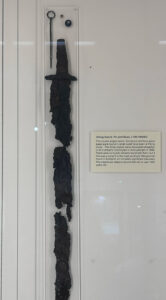
workmen came across a type of Norse or Viking sword together with a cloak pin and a glass bead. No skeletal remains were found, but the group of finds is typical of a pagan burial of a sword-carrying Viking freeman. These finds can now be seen in The Stewartry Museum in Kirkcudbright. But why was a pagan Viking buried near an early Christian church? Such a burial fits the hypothesis that men of Viking descent were encouraged to settle on the Stewartry coast, receiving land in return for military service to counter the threat of attacks by other Vikings or Gaelic-speaking raiders from Ireland. The Norse derivation of place-names in these areas, such as ‘Borgue, ‘Rerrick’, ‘Rascarrel’ etc. is thought to be further evidence of this deliberate settlement policy.
The kirkyard contains several interesting monuments. The earliest gravestone, dated 1620, commemorates a John Shawe, and the large and impressive Renaissance monument to the left of the main
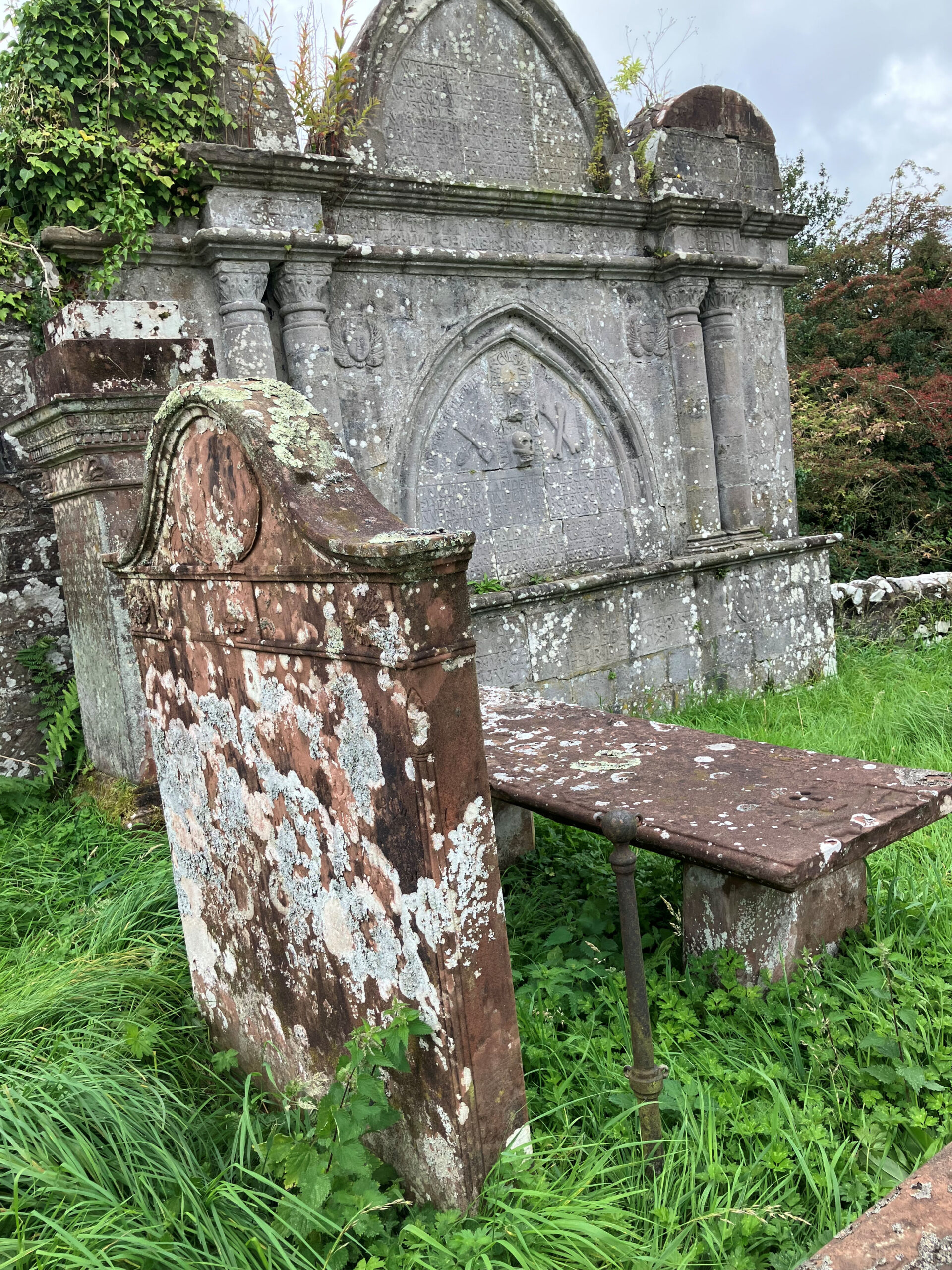
gate was erected by John Ewart in memory of his son Andrew in 1642. It is thought that several of the 17th and 18th centuries gravestones here were moved from the Moat Brae in Kirkcudbright, after the former parish church (built 1730) on that site was partially demolished, when it was superseded by the new parish church erected on its present site on St Mary Street in 1838.
Other notable headstones commemorate Billy Marshall – ‘the Gypsy King’ – who died in 1782 at the age of 120, Admiral John McClure of the Chinese Navy (1837-1920) and several of the Kirkcudbright artists including E A Hornel, William Robson and William Hanna Clarke, whose headstone was carved by his friend and sculptor Edward Proudfoot RSA.
Headstone inscriptions are a very important source of information for family history research. All the Stewartry cemeteries and kirkyards were surveyed by teams operating under the Manpower Services Commission in the 1970s. Subsequently their reports were checked and republished by the Scottish Genealogy Society. Copies of both reports are available for consultation in the Stewartry Museum and Kirkcudbright Library and are used on a daily basis for family history research.
David Devereux (April 2026)