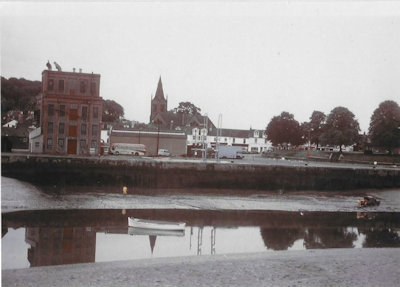
Tidal processes cause silt to build up in Kirkcudbright Harbour, so regular dredging is needed to maintain safe depths and access for fishing vessels and other users. The work began in 1956 to provide safe access for Shell Mex tankers, with the company’s lorry drivers initially clearing the harbour using hoses.
David Collin’s talk to the History Society traced a lifetime of connections between the sea and Kirkcudbright. Born in a cottage on the St Mary’s Isle Estate while the ruins of Isle House still smouldered, he is still living in a cottage there 85 years later. He bridged the intervening years with reminiscences and coincidences showing how Kirkcudbright followed him to distant places. If you missed last night’s entertaining and informative talk, you can watch it on YouTube here: https://www.youtube.com/watch?v=W_f1ImoSpxQ&t=24s
We have received an enquiry about a medal awarded to I. Palmer in 1931. The address listed is “Collieburn, Kirkcudbright”. Does anyone know where this was? Palmer may have been a farmer or smallholder, as the medal was awarded for egg-laying trials. We also found a reference to Collieburn in a local diary from 1940. “Jean and I had a “brambling expedition” in the afternoon, left Town [Kirkcudbright] about 2 and returned about 7 o’clock. Picking on the roadside near Collieburn and easy picking, great crop lovely and dry”. Any ideas contact secretary@kirkcudbrighthistorysociety.org.uk
Are you J Thomson, and did you recently pay for a two-person membership with Kirkcudbright History Society? If so, please contact our secretary at khsoffice44@gmail.com.
The promised book, ‘Eighty Letters to Canada’ is hot off the printing presses and is now available in the UK! This limited print run of books is being distributed by John Sproat of Glenlochar, Castle Douglas. His cousin and co-author Paul Sproat is having the identical book printed and distributed independently in Canada.
The letters tell an extensive, interesting and diverse story of the first half of the Nineteenth Century, and one that covers anything from the state of Galloway agriculture to tales of colonial emigration, from life on ocean-going clippers to gossip from Borgue, schisms in the Church to life in Canada and Australia, and much about the families living in the area. Did you know that Chilean ladies had smaller feet than Scottish ones, or that Andrew Main, an alumnus of Borgue Academy, lost an arm in his uncle’s joinery business in Chapelton Row, and emigrated to teach Latin and Greek in Poughkeepsie, NY State? Such a myriad of gems!
In Gatehouse of Fleet the short walk from the church, along the road to Barwhill and then back to Gatehouse via the War memorial is known as going roon ‘The Cape’. The derivation has always been a mystery until Stuart Nicholl told Margaret Wright about the ‘kep’ or sluice gate. The old expression he says was going roon ‘the kep’.
After the last spell of heavy rain, the garden at Barwhill [near the walk’s turning point] flooded slightly and a large hole appeared. Stuart Nichol, a local builder and dyker, told Margaret that a collapsed kep had caused
Kep at Barwhill
the flooding. He explained that kep is an old term for a type of sluice gate that held back water in the lade system—overnight, for example—before releasing it in the morning to power the mill. She suspects there was once a holding pond near Barwhill.
The water is part of the lade system from Loch Whinyeon. It runs alongside the road from Barlay Mill and then underground through the garden of Barwhill.
The water from here could either be sent on down to the large mill pond at the foot of the Cut (by the war memorial) and then down to the Birtwhistle Mills or it could be diverted off down the Cape Road to the Gatehouse/Fleet Farm next to the church.

 Shell Mex tankers, with the company’s lorry drivers initially clearing the harbour using hoses.