
William Anderson was born in 1919 at Mutehill. Here his daughter Mary Warner shares her father’s account of his experiences during the Second World War.
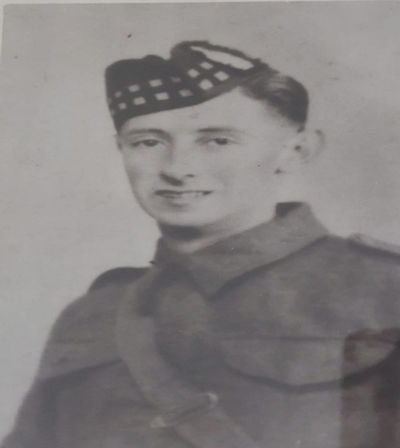 William was encouraged by his family to make a record of his life, particularly for his grandchildren. Much of what follows is either a direct quote from his recollections or a synopsis of his comments.
William was born in 1919 at Mutehill. He recalled his childhood as not easy by the standards of today but a happy one. Before school he would milk his Grandmothers cows and then walk into Kirkcudbright to attend the Johnston School. He enjoyed school days and had a lifelong love of learning. Many years later William proudly showed his children his name on the Dux Board which was then in the entrance hall. The Academy proved to be equally as happy for William. He could still recite the school song well into his nineties. He excelled in his academic studies but was told by the Woodwork master that “you will have to make your living with your brains boy because you won’t make it with your hands”.
Family finances meant that William could not continue his education so he became a Grocers Boy, making deliveries in the town and countryside on his trusty bike.
Life was to change though in 1939. William volunteered for military service in June and made his first ever train trip to go to Dumfries for his medical. He wanted to join the local regiment, KOSB’s and was duly called to Berwick to enlist. After a period of training William and comrades were on coastal defence duties until the threat of invasion seemed over. He then volunteered for the Far East leaving from The Clyde on 16th February 1942.
The highlight of the voyage for William was being elected to represent his draft in a spelling Bee. He records that he “won in a very tough contest against a Green Howard.” He would always say that it showed the benefits of his Academy education.
Upon disembarkation his detachment travelled to Razmak to join the rest of the Regiment on mostly border defence roles. Meantime the Japanese Army had not only captured Singapore and Malaya but fought their way through Burma and were now on the threshold of India and inevitably more troops were needed to support battle weary soldiers already there.
The journey to Burma saw their first experience of monsoons and the need for vigilance over the local wildlife. Shoes and sleeping bags had to be checked before you ventured into them. Dad did comment though that he saw very little in the way of monkeys or snakes who all seemed to be put off by the sound of war.
It soon became clear that “We were headed to the dreaded Arakan, a place which drew the same feelings of dread from us as The Somme must have done to the previous generation”.
Most of the roads and tracks were impassable to wheeled vehicles so every journey (except one, of which more later), would be made on foot. Each soldier carried his own rifle and kit bag which would get heavier as it got more and more sodden. The mules would carry heavier equipment particularly artillery and were invaluable for all troop movements.
The battle raged for several weeks and at one point the division was cut off completely for three weeks. During this time the RAF dropped food, munitions, medical supplies and fodder for the mules but most important was the tea. “The RAF no doubt saved our lives then and at other times and always seemed to get through. What a debt we owe them and not just in Burma.”
The fighting was prolonged and fierce, though new leadership under Lord Louis Mountbatten and General William (Bill) Slim managed to turn the tide of the Battle leading to the first defeat of the Japanese in Burma. It was about this time that William got his first bout of malaria. Typhus and Malaria are known to have caused almost as many casualties as enemy fire. He was sent to Hospital for initial treatment and then sent back to The Casualty Clearing Station to continue his treatment. The hospital was attacked the night after he left and most of the patients and staff were killed.
There was not much time to rest however as the Japanese, who were less well supported by air, were running short of supplies.
Their intention was therefore to capture the hill forts of Imphal and Kohima together with the supplies held there. This led to the only journey undertaken in Burma that was not on foot.
“we were to fly from The Arakan to Imphal together with the mules. There were orders to shoot the mules if they threatened the safety of the aircraft. I’m not sure which would have been worse.”
Having landed without incident “our first task was to capture Kangatongbi Ridge about ten miles from Imphal. The attack was planned as a dawn operation, and in monsoon weather was very tricky. Streams could soon become deep rivers and it was two steps forward and one slip backwards.”
The whole operation took more than three weeks and casualties had been heavy and the fighting fierce.
The next objective was the village of Ukruhl. “Everything we needed was on our backs. Some of the hills were 3000 feet and the valleys knee deep in mud. It was scrub typhus country with a vengeance.”
The Regiment continued towards Rangoon, though the retreating Japanese forces were fighting every step of the way. The crossing of the Irrawaddy River again cost many casualties as the boats were often inadequate for the job and the river was swollen by monsoon rains. One of those casualties was Clark Corson from Castle Douglas who was an Officer with the Gurkhas. He died trying to rescue one of his soldiers who had fallen into the river.
On arrival in Rangoon they learned that the Navy had bombarded and captured the city and the Japanese had already left.
For William his war was at an end. Those men who had served more than 3 years were to be sent back home and the others returned to India. While happy to be returning home, “the few of us that were left reflected sadly on those faces who came out with us but would never be returning home”.
William and his comrades returned to The Clyde in October but not to cheering crowds as had been the case for soldiers returning home from Europe though a few fishing boats blew their horns in greeting.
William spoke very little about his time as a soldier, and never mentioned the atrocities that he no doubt witnessed. He did however always speak proudly and with great fondness of his comrades and the honour of being a KOSB.
“We were a family.”
Submitted by his children Mary Warner and Gordon Henderson.