https://www.bbc.co.uk/news/articles/c674kx0jgpj1o

In Gatehouse of Fleet the short walk from the church, along the road to Barwhill and then back to Gatehouse via the War memorial is known as going roon ‘The Cape’. The derivation has always been a mystery until Stuart Nicholl told Margaret Wright about the ‘kep’ or sluice gate. The old expression he says was going roon ‘the kep’.
After the last spell of heavy rain, the garden at Barwhill [near the walk’s turning point] flooded slightly and a large hole appeared. Stuart Nichol, a local builder and dyker, told Margaret that a collapsed kep had caused

the flooding. He explained that kep is an old term for a type of sluice gate that held back water in the lade system—overnight, for example—before releasing it in the morning to power the mill. She suspects there was once a holding pond near Barwhill.
The water is part of the lade system from Loch Whinyeon. It runs alongside the road from Barlay Mill and then underground through the garden of Barwhill.
The water from here could either be sent on down to the large mill pond at the foot of the Cut (by the war memorial) and then down to the Birtwhistle Mills or it could be diverted off down the Cape Road to the Gatehouse/Fleet Farm next to the church.
Alan’s research into the word kep:
 Parton Kirk, the burial place of the world-famous physicist James Clerk Maxwell, is being sold by the Church of Scotland.
The community of Parton, has been offered the exclusive right to buy the Kirk with the idea of developing a James Clerk Maxwell Science and Community Centre to celebrate the life and work of this great mind, a scientist who laid the foundations of our modern society, yet remains relatively unknown outside the world of science and engineering
Clerk Maxwell is known as the ‘Father of Modern Science’, and his classical theory of electromagnetic radiation (the first theory to describe electricity, magnetism and light as different manifestations of the same phenomenon) is the basis of all our modern communication.
This places him between Newton and Einstein in the chronology of scientific discovery that shapes our understanding of the physical world, and yet he still remains relatively unknown in his own country!
To help Parton secure the Kirk for their community, and to celebrate the life and achievements of this giant of science you can donate here. https://www.justgiving.com/crowdfunding/savepartonkirk?fbclid=IwY2xjawUHgV9wZG9mAWV4dG4DYWVtAjExAHNydGMGYXBwX2lkEDIyMjAzOTE3ODgyMDA4OTIAAR5-LKxM8DzsLj-YC-Ka3Erog1TKqJZkyA-4IfFhFXzWlphiN0NX41aaS4ZMtw_aem_GF85iuKqzpUmpFTrZ0cbrA
The programme and membership form for 2026/2027 can be accessed here:
 Talks are held in Kirkcudbright Parish Church Hall at 7.30pm on the second Wednesday of the month from October to March. They are also live streamed via Zoom.
Annual KHS membership of £15 gives free entry to all talks, in person or on Zoom. KHS members also have free Zoom access to the lectures of both the D&G Natural History and Antiquarian Society and the Ayrshire Archaeological and Natural History Society.
Visitors (in person or on Zoom) are welcome to attend for a fee of £5 per meeting (Zoom access payable by BACS).
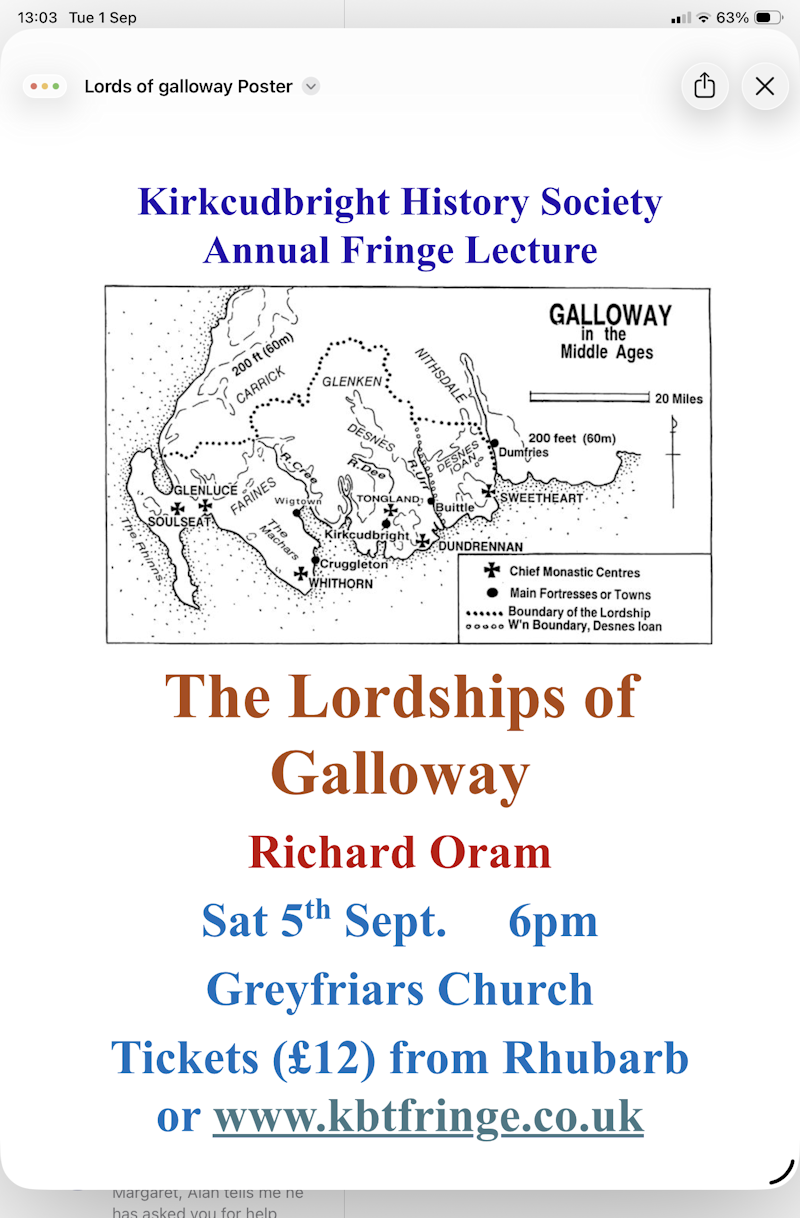
The Society is going to be busy over the Fringe weekend with 4 walks and a lecture. Please note the walk information is at the end of the posters.


Jim Bell has been posting articles on Facebook which cover a lot of local history. He has kindly allowed us to copy these and post them on our website. They continue to be very varied and interesting. They can be accessed here. https://www.kirkcudbrighthistorysociety.org.uk/category/featured-article/jim-bell-blog/
Cochran Hall, Kirkcudbright Academy.
If you’ve ever spent time at Kirkcudbright Academy, or attended a local event in the town, you’ll almost 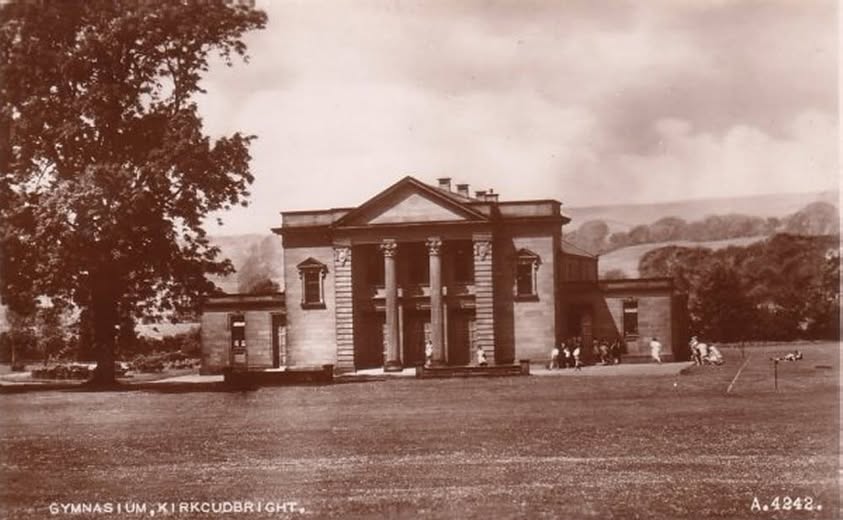 certainly be familiar with the Cochran Hall. It’s a key part of the school’s footprint, serving as everything from an examination room and sports venue to a hall for community gatherings, but the story behind its name belongs to a world far from the Stewartry. The hall owes its existence to Thomas Cochran, an American investment banker whose generosity reconnected him with his family’s Scottish roots.
Born in St. Paul, Minnesota, in 1871, Thomas Cochran rose through the ranks of American finance to become a partner at the prestigious New York firm J.P. Morgan and Company. Despite his life being firmly rooted across the Atlantic, his family tree stretched directly back to the Stewartry, where his ancestors had lived generations earlier. He wasn’t someone who regularly walked the streets of the town, yet his lineage meant that when Kirkcudbright needed support, his name was high on the list of people to contact.
Kirkcudbright Academy underwent a major period of modernisation and expansion in the 1920s to cope with its growing role as the main secondary school for the surrounding district. The Kirkcudbright artist Edward Atkinson Hornel, who was himself a former pupil, sat on the local education committee and took an active role in raising funds for the project.
Hornel wasn’t hesitant about looking further afield, and among those he contacted was Thomas Cochran in New York, whose family had left the Stewartry generations earlier.
When Hornel’s appeal reached Cochran, the banker responded with remarkable philanthropy. He offered to finance a brand-new facility for the school as a lasting memorial to his Kirkcudbright forefathers. Designed
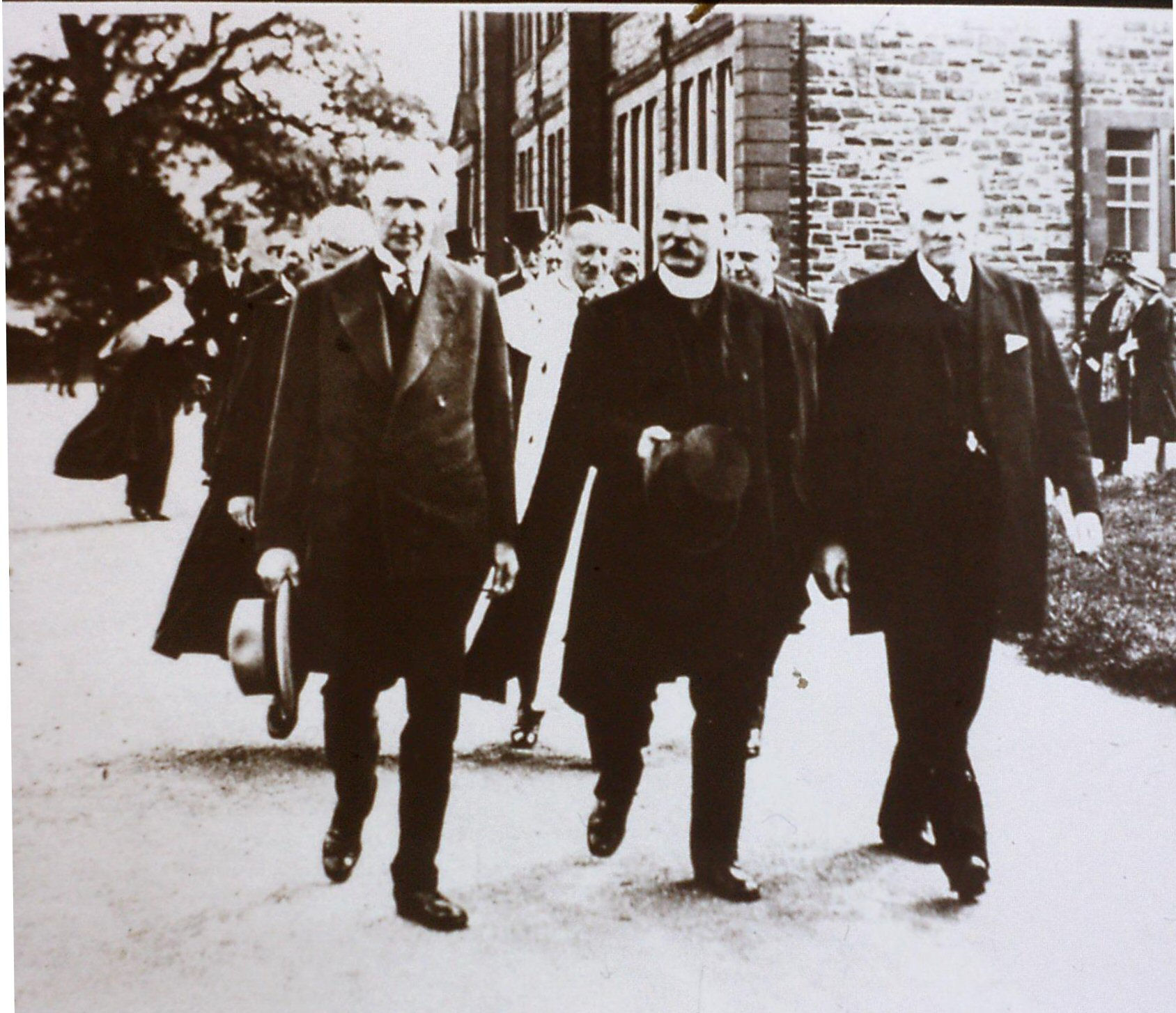
by the architect W.A. McKinnel, the building opened in 1931 as the Cochran Memorial Gymnasium. It was considered a fine addition to the academy, providing physical education facilities that were well ahead of their time for a rural school in the region.
Over the decades, the building expanded its role to become the versatile assembly space known today as the Cochran Hall. It’s played host to generations of school events, theatrical performances, and long-standing community traditions such as the annual Candlemas Ball. Though Cochran passed away in 1936 having spent his life in the United States, his gift ensured that his family name would remain stitched into the social and educational life of Kirkcudbright