Kirkcudbright Common Good: Port, Art, and Land Held in Trust
Kirkcudbright’s Common Good assets are older than most in the Stewartry. As a Royal Burgh, confirmed by Charles I’s 1633 charter, the town has held land and property in trust for its inhabitants for nearly 400 years. Today’s Common Good is more than a balance sheet. It is a physical record of Kirkcudbright’s history as a port, an artists’ town, and a farming community.
Maritime roots
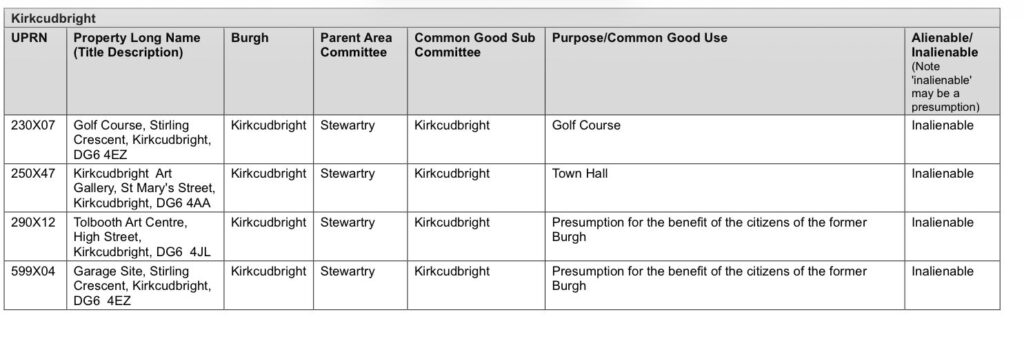
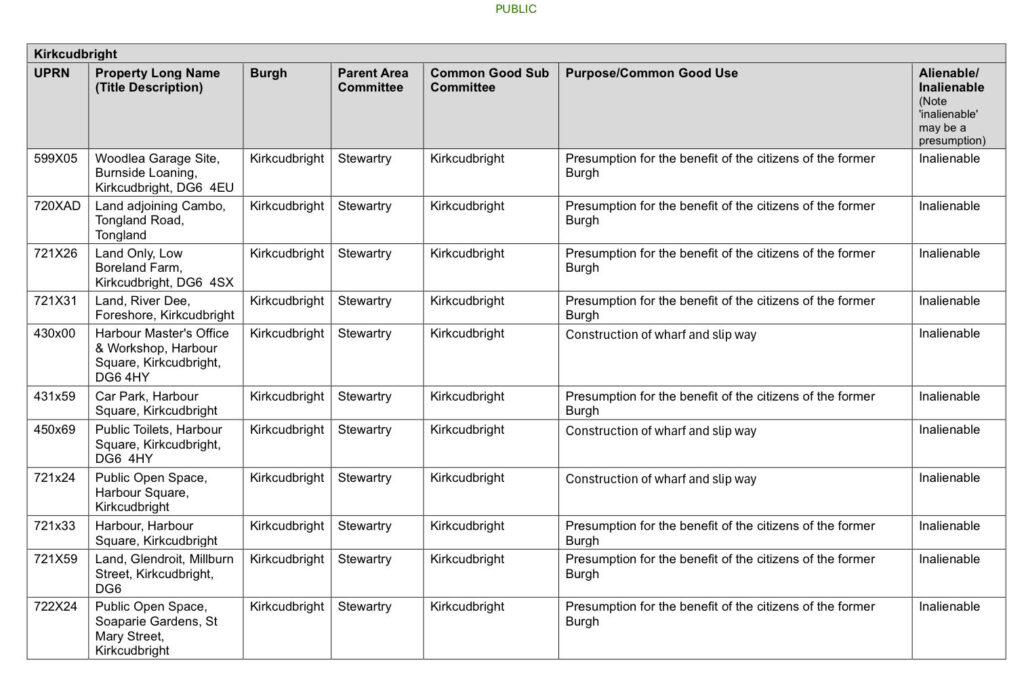
The harbour remains the anchor point, so to speak. The Harbour Square, bought by the Burgh in 1908, is still the town’s public front room, and the working harbour is the busiest commercial fishing port in Dumfries and Galloway. People in the town often include the Harbour Master’s office and the Mews Lane workshop when they talk about the Common Good estate. The frontage along Dee Walk is also widely assumed to be part of it. None of these appear in the valuation papers I’ve seen, so they sit in that familiar Kirkcudbright category: locally accepted, historically plausible, but not formally confirmed.
The “Artists’ Town”
Kirkcudbright’s creative reputation is part of the fund. The main public venue is Kirkcudbright Galleries on St Mary Street, used for exhibitions like “Common Ground; The Living Landscape”. The Tolbooth on the High Street is central to the town’s arts heritage and is commonly cited as a Common Good building. Council investment reports list financial holdings, not a property register. Both venues are strongly linked to Common Good, but I can’t cite a definitive entry here.
Green space and sport
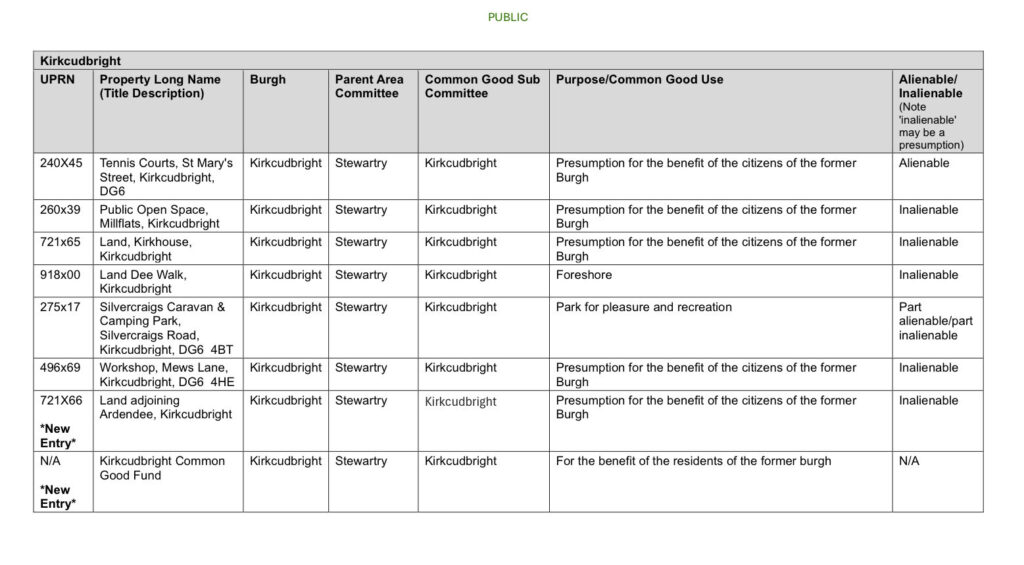
The Common Good goes beyond the waterfront. Millflats and Soaparie Gardens provide open ground in the town. Silvercraigs Caravan and Camping Park is part of the portfolio, along with the local golf course and tennis courts. There is also farmland. Land at Low Boreland Farm reflects the Burgh’s agricultural gifts. Small sites like garage plots at Stirling Crescent and Burnside Loaning appear in local discussion of Common Good holdings. They aren’t named in the published valuation docs, so they remain plausible but speculative.
Together, the confirmed and likely assets show a Royal Burgh that kept its historic core. The 1633 charter still matters. From Harbour Square to the Galleries, from caravan parks to farmland, land gifted by the crown continues to serve the social and cultural life of Kirkcudbright today
Kirkcudbright Artists’ Collection
While most Common Good assets are “heritable”, meaning land and buildings, the funds also hold “moveable” assets that are just as central to a town’s identity. In the case of Kirkcudbright, this takes the form of an incredibly significant art collection. It is entirely appropriate that the “Artists’ Town” holds its creative legacy in the same communal trust as its harbour and town hall, ensuring that these works belong to the residents rather than disappearing into private hands.
The paintings held within the Kirkcudbright Common Good are a “who’s who” of the influential Kirkcudbright School and the wider Glasgow Boys movement. Among the collection are works by the Faed family, who were instrumental in establishing the town’s reputation in the nineteenth century, as well as pieces by Charles Oppenheimer and the Scottish Colourist Samuel Peploe. One of the more evocative works in the council’s care is Archibald Standish Hartrick’s depiction of the “Kirkin’ of the Incorporated Trades,” which captures a unique piece of the Royal Burgh’s civic and religious ceremony.
These paintings aren’t simply decorative pieces. Museums Galleries Scotland recognises them as a Nationally Significant Collection, reflecting both the quality of the work and the importance of Kirkcudbright as a place where artists lived and worked side by side. Alongside the larger canvases are more personal items — Lena Alexander’s paint box, Jessie M. King’s illustrated sugar pots and silver buckles — objects that bring the colony’s daily life into focus in a way that landscapes alone cannot.
The stewardship of these items has evolved alongside the town. For years, many of these works were showcased in the annual exhibitions organized by the Kirkcudbright 2000 group in the Town Hall. Today, the permanent home for these Common Good assets is the Kirkcudbright Galleries. By housing the collection in a building that is itself a Common Good asset, the town has created a self-sustaining cycle of heritage. The presence of these paintings ensures that while the artists themselves may be gone, their vision of the Stewartry remains a permanent part of the town’s communal wealth, accessible to everyone who walks through the gallery doors.
A final word about the complex legacy of our local Common Good assets.
When Dumfries and Galloway Council absorbed the old burgh and county authorities, they inherited not just physical property, but a legal obligation to preserve these resources for their original communities. It hasn’t been a straightforward process. The central challenge is that many historic assets demand substantial maintenance, yet the associated Common Good funds are often inadequate to cover the bills. Kirkcudbright Tolbooth is a good example, where preserving a piece of local heritage comes with considerable ongoing costs. However, the real strength of this designation is that the council cannot easily dispose of these assets; they must undergo formal community consultation and, for historic property, secure court approval to do so. While safeguarding these treasures is important for local wellbeing, striking a workable balance between preservation and financial reality remains difficult for the modern authority.
During July-September 2026. Dumfries and Galloway Council issued a consultation on The Common Good Register. The following is the list of assets as owned by Kirkcudbright Common Good. Edit.