Located where Wilkinson’s now stands in Castle Douglas, in the late 19th and 20th century Wallace’s was a major manufacturer of Agricultural Engineering products. A fine example of Scottish Victorian enterprise.
Established in 1876 by brothers James & Robert Wallace, sons of Robert Wallace, an implement maker from Ayrshire, at its peak the Company employed between 60 and 70 people including turners, fitters, moulders and wheelwrights.
Presenting her material with authority, liveliness and enthusiasm Anne provided a summary of how female costume has changed since the time of Queen Elizabeth I.
Her talk was supported by a well chosen range of images. She showed us how what was worn could tell us much about social history, the power and influence of who was wearing the costume as well as about what was fashionable or unfashionable at the time.
At a meeting of Kirkcudbright History Society on November 13, Luke Moloney, an Architect in private practice in Dumfries, spoke about Buildings at risk in Dumfries and Galloway.
What emerged from his talk is that this is a matter of major concern in our region. Using a wide range of images he illustrated how over the past 40/50 years many buildings have been destroyed, allowed to deteriorate or been demolished in Dumfries and Galloway and many buildings are under threat today.
Mark Mulhern, Researcher, European Ethnological Research Centre, Edinburgh University
Ethnology deals with the detail of life at different times and in different places. Typically it is done by using documentary sources of different kinds like diaries and letters. It also makes use “oral” evidence based on interviews and discussions.
Mark Mulhern and Caroline Milligan, based at the University of Edinburgh, and Alison Burgess from Dumfries separately described different aspects of this major current project in which they and others are involved.
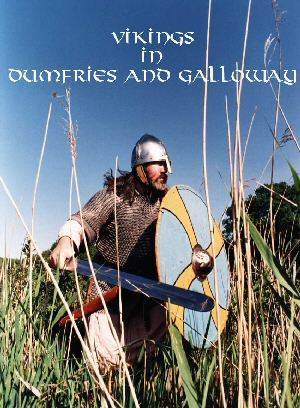
Over 70 members and guests of Kirkcudbright History Society were treated to a lively, informative, illustrated talk on the Vikings in Dumfries and Galloway at their first meeting of the winter season.
The speaker wearing Viking dress and carrying weapons and implements of the period was “Guthrum Thor Wulfsson”; better known locally as Andrew Nicholson, Historic Environment Record Officer with Dumfries and Galloway Council. Andrew has considerable local knowledge and practical expertise on the Vikings and gave a clear insight into their influence in our region.
Over 70 members and guests attended the first Kirkcudbright History Society meeting of 2013 on January 9th.
Donald Cowell, who is a volunteer working in the Stewartry Museum a few hours a week, has been recording the contents of three boxes of prison records and talked about his work.
What the records reveal is a fascinating story of Kirkcudbright prison and prison life between 1791 and 1857.
Originally all Scottish burghs like Kirkcudbright kept prisoners in Tollbooth gaols. The two most famous prisoners held in Kirkcudbright Tolbooth were Elspeth McKewan, the last Witch to be burned in Galloway in 1698 and John Paul Jones, the American Naval hero, who was held there on a murder charge in 1770.
As imprisonment became a more common method of dealing with criminals from the early 19th century a new prison was needed and opened in 1816. It operated until 1885 when a new prison opened in Dumfries.
The Kirkcudbright prison building, a castellated tower 75 feet high, adjacent to the Court, is still an important feature of the town skyline.
Major changes were made to the Scottish prison system, punishment methods and prison regime during the early 19th century. In 1839 a more centralised system was introduced in Scotland.
The audience was reminded that Banishment, as a punishment was only abolished in 1830; Transportation to Australia was in operation until 1867; Whipping was abolished for females in 1820 but continued for men over 16 until 1862; and the use of Public Humiliation like being put in the pillory was only abolished in 1836.
The prison building was altered in 1842/43 to provide more individual cells and a new Keepers house was built behind the prison.
Records of prisoners, their offences, the time they spent in prison and their behaviour have survived. At that time people could be imprisoned for being in debt; there was no separate provision for lunatics until a special wing was opened at Perth prison; and children over 12 could be imprisoned.
The names and some details of their gaolers have also survived. For a few months in the 1830’s Kirkcudbright had a female gaoler, Margaret Miller, the widow of Robert Miller who died in service. Also for a time after 1840 the Kirkcudbright gaoler had over sight of other gaols and lock ups in the Stewartry including Maxwellton, Castle Douglas, New Galloway, Gatehouse of Fleet and Creetown.
The more formal prison regime introduced in prisons included the wearing of a uniform, opportunity for exercise, regular visits from a doctor and from the local minister of religion. Prisoners serving three months or more could be taught to read and write if unable to do so. The diet was considered to be “cheap but wholesome” and largely consisted of oatmeal made into a porridge, and barley made into a broth with vegetables, marrow bones and seasoning with bread and buttermilk.
Prisoners were required to wash once a day, wash their feet once a week and have a bath once a month. Male prisoners were shaved once a week.
Prison reports became a routine part of prison management and those surviving in the records reveal much about prison conditions and how prisoners were looked after.
The prison was important to the local economy. Gaolers had to be paid. Prisoners had to be fed and clothed. Local shops and traders supplied many of the goods and services needed. Bread, milk, meat, vegetables, oatmeal and barley were provided by local business.
Coal for heating the prison was shipped in from Whitehaven. Specialist stationery for prison journals and records came from Edinburgh. Cloth and blankets came from Glasgow and Dumfries. Old rope unravelled to produce oakum for caulking ships was sent on the “Countess of Galloway” from Liverpool.
Donald Cowell concluded that the surviving prison records provide a unique and rich record of the operation of the prison system in the town of Kirkcudbright.
First published in the Galloway News on 29 December 2012
Yair nets were an unusual and distinctive feature of the River Dee for several hundred years, the last example only falling into disuse in the late 1960s or early 1970s. I don’t know of any other places where yair netting takes place, so it is important to record as much as possible about the locations on the Dee where it was practised, the construction techniques used and the method of operation while first-hand accounts are still available.
St. Cuthbert’s Churchyard is of particular historic interest. The older, lower part of the cemetery is known to be the location of the original ‘Kirk of St.Cuthbert’, established perhaps as early as the later 700s when Galloway was part of the Anglian kingdom of Northumbria. The church may have been an important mission centre or minster to spread Christianity in this part of Galloway. The new church was dedicated to the patron saint of Northumbria – St.Cuthbert. Although the church has long since gone, its name moved down the hill to the burgh and port which was established after it on the banks of the Dee – Kirkcudbright.


 Anne Ramsbottom