
The Haill Six Incorporated Trades of Kirkcudbright were established in the town in 1425. In this year it was enacted that ‘every craft in the town should choose a wise man’, a Deacon to ‘govern and assay’ all its handiwork. The Trades were set up in direct opposition to the Merchant Guilds which held disproportionate influence in the community and who had amassed enormous wealth.
Membership of the Trades was much sought after as it allowed in many cases, the right to be a sole trader in the town. The Government of the 15th century quickly realised that the powers enacted on the Trades conferred too much influence on the Deacons. Their duties were soon restricted to a fortnightly enquiry into the skill of its members and quality of work produced. The position of Deacon was summarily abolished. The Trades men refused to accept this and continued to elect Deacons, an act which was seditious.
By 1456, as a result of “resent and rebellion” by the Trades, a Royal Proclamation was enacted, that every Trade should be allowed to elect its own Deacon.
The Trades were incorporated by an Act of Council on 4th October 1598.
The Town Council Minute of that date reads;
‘The saidis Provost, Bailleis and Counsall, in respect of the supplicatioun gevein befoir thame be the craftismen qliks ar burgesses of this burgh, anent the hurt susteint be thame be the resorting of unfreman craftisman in this toun; hes therefore grantit , according to the use of uthir burrowis; and the saidis deaconis to be anshirable for ilk fault to the toun commitit be their craftsmen.’
They have been in continuous existence since they were instituted by King Charles 1 on 23rd July 1633.
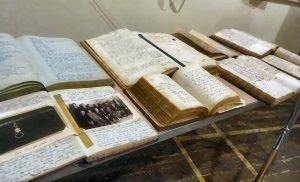
Minute books for the Incorporated Trades are extant from the early 1700’s. Each Trade has its own minute books, and in some cases minute books for Journeymen and Apprentices. The minute book for the Annual General Meeting dates back to 1720.Earlier minute books were sadly lost in a fire in a Deacon Convener’s house.
The minute books are a fascinating record of significant local and national events, social history and the development of the town over the years. Some of these can be found in the Stewartry Museum.
The partnership between the Trades and the Council was not always an easy one. Disagreements often escalated to violence and disorder before calm was restored. Minute books record Journeymen being called to meet with Deacon’s Court for misdemeanors such as working outwith the rules of the organisation, refusing to act as directed by the Deacon or failing to attend legally convened meetings.
The composition of the Incorporated Trades is as that of six trades, Squaremen, Tailors, Hammermen and Glovers, Shoemakers, Weavers and Clothiers. In some cases, dyers and wig makers were allowed to join the Clothiers Incorporation although numbers were very small.
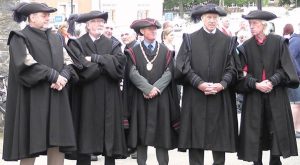
A Deacon Convener is democratically elected each year at the Annual General Meeting along with a General Clerk (secretary), Box master, (treasurer) and General Office (assistant to the General Clerk and Box master).
Within each Trade, there is a Deacon, Clerk, Box master and Assay Master who was responsible for examining the quality of work produced.
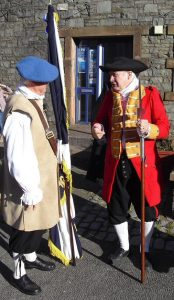
Protection for the Deacon Conveners was provided by the Halberdiers who also provided the same function for the Provost.
The Incorporated Trades had a strong voice in the running of the town of Kirkcudbright. They did not always reflect what would be seen today as inclusive views, for example, they petitioned Parliament in 1829 against any relief being given to the Emancipation Act of that year.
They did however petition in favour of the Reform Act of 1832 which was the beginning of political reform in the country. It would be almost 110 years before women got the vote!
The Incorporated Trades dabbled in the Kirkcudbright Shipping Company in 1811, both the Trades and the Hammermen invested in the company which owned the ship ‘Britannia’. This was the time of the Napoleonic Wars and privateering opportunities were possibly seen!
The year 1846 saw the end of all powers and privileges bestowed on the Incorporated Trades in Scotland. Deacon Convener David Ewart inscribed the words ‘open sesame’ in the minute book. The function of the Incorporated Trades changed to that of a more ceremonial role, however, many influential individuals were members of both the Town Council and Incorporated Trades.
The ‘Siller Gun’, the oldest sporting trophy still competed for in the country, possibly the world, was presented to the Royal Burgh of Kirkcudbright in 1587 by King James VI of Scotland. This was in order to ‘Instruct the lieges in the use of firearms’ at a time where guns were replacing archery as a form of defence.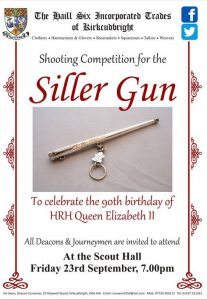 The gun bears the initials of Thomas McLellan of Bombie, Provost of Kirkcudbright. Records of the gun being competed for by the Trades exist from 1781, to celebrate the Earl of Selkirk’s coming of age. The gun has been shot for on approximately fifty occasions since, mainly to celebrate hatches and matches of the Royal family. Significant events such as the opening of the first bridge in the town and the end of the wars in the 20th Century were celebrated by a shoot. Robert Burns birth centenary was shot in 1859, the only time it has been competed for to celebrate a ‘commoner’.
The Silver Arrow, a model of an arrow, which was presented by William Johnston in June 1838, is used as a prize for the apprentices at the same time as the gun competition. Nowadays it is more often used as the runner’s up prize. It was made from 3 half crowns by William Law a local clockmaker.
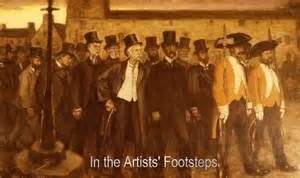
The Incorporated Trades have had many notable members over the years, James Cochran, E.A. Hornel, W.S. McGeorge, William Mouncey, James Nicholson, the aforementioned William Johnston, Miles Johnston and Dr.David MacMyn. Several of these can be seen in the painting by Hattrick which is in the Tolbooth Art Centre
Robert Erskine was Deacon Convener in 1791 and in 1953 his great, great grandsons presented the Incorporated Trades with the Deacon Convener’s solid gold chain and new Coat of Arms which proudly overlooks the Kirk from the Trades Gallery.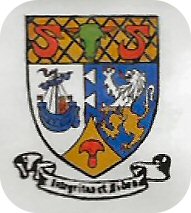
The minute books record the names of Provosts, Baillies, Writers (Lawyers) , bank managers, Town Clerks, teachers, Rectors, Ministers, prominent businessmen, hoteliers, farmers and many more who shaped the Town in the 20th Century. . They also record the names of ordinary men whose families gave generations of service to the Incorporated Trades without holding office. This was a time where the Incorporated Trades could admit anything between 20 and 50 new members per year.
The latter part of the 20th Century saw a huge decline in membership and interest in the Incorporated Trades. However, the organisation is having something of a renaissance in recent years with links being established with other Trades organisations in Scotland and England. A programme of modernisation has included the admission of female members in 2016 and the joining of the first apprentice for 40 years. The profile of the Incorporated Trades has been raised by the use of social media with thousands of ‘hits’ worldwide and the translations into fifty different languages.
The Incorporated Trades continue to play an important part in the social fabric of the Town. Historic events such as the Kirkin’ of the Deacon Convener and the Kirkin’ of the Cornet are carried out every year with the Trades taking their place in the Trades Gallery in the Parish Kirk. Involvement in the town’s affairs continues through representation on the Community Council. The Trades remember the fallen on Armistice Day, remember our National Bard with an annual Burns Supper and participate in the Summer Festivities in the town.
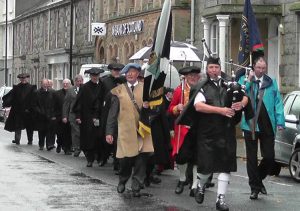
‘Integras et Fides’