
The following piece was posted on Facebook on the Dumfries and Galloway Old Places: the story in the stones page. It is reproduced here with the permission of RMSmith.

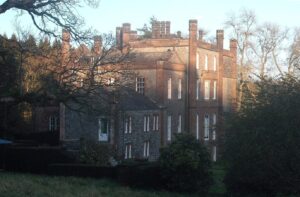
“Looking across the tidal flats of the River Dee in the direction of Kirkcudbright, Cumstoun House is a large 19th century mansion built mainly in a Tudor Gothic-Revival style. I believe the Maitland family have owned the property since its construction around two hundred years ago. Thomas Maitland, Lord Dundrennan, is in some sources** described as having been born at Cumstoun in 1792. As this date precedes the date of the present house by over 3 decades, it raises the possibility of there having been an earlier residence on the site.
 Not instantly noticeable, a still older seat of lordship lies a few hundred yards to the SW. ‘Cumstoun Castle’ is a late-medieval rectangular tower-house, now ruined. Its builders were most likely the Kennedys, though in later time ownership passed to the MacLellans, then the Dunbars.
The mound on which the tower stands may be another example of an early motte having been constructed upon – although another now obscure earthwork north of the mansion, depicted on maps as ‘Castle Hill’, could be the site of Cumstoun’s very first (earth-and-timber) fortalice”.
** There is debate about this as the following has also been researched.
Cumstoun is given as the location of Thomas’ birth in the Dictionary of National Biography (copied by Wikipedia) but the Maitland family histories on the internet give ‘Dundrennan Abbey’ as his birthplace – in fact the abbreviated Wikipedia summary for Thomas Maitland, Lord Dundrennan also states that, although the main text of the article states Cumstoun. I suspect the DNB is wrong on this occasion.
Following the appearance of this piece Alan James has given us his thoughts on the derivation of Cumstoun.
Combistoun in 1331, Cumyston 1504, Kumstoun, Cumston on Blaeu’s maps 1654 (based on Pont’s survey c1590), Compstone on the 1854 OS map, but Cumstoun today. Sir Herbert Maxwell in The Place-Names of Galloway 1930 stated ‘Evidently a “toun” or dwelling with the owner’s name, which is worn beyond recognition’. He may well have been right, but it’s worth noting that a line of hills north of Croglin Water in Cumberland is called The Combs, and there are other examples of ‘comb’ being used in names for hill-crests; the 1331 record Combistoun might suggest that the rows of steep ridges both north and south of gorge between Cumstoun House and the castle site were known by the same name.
Another possibility might be Middle English combe, ‘a valley’, but usually a broad, short one, the opposite of the glen at Cumstoun, and the –is- would be hard to explain either as the possessive form of a personal name or a plural, as there is only one valley. ‘Comp-‘, as in some of the many Comptons in England, can also be a reflex of Old English camp ‘battle, dispute’, but the records imply that the ‘p’ in Compstone was a recent and temporary intrusion.