
E.A. Hornel: Painter of Galloway’s Enchanted Landscapes
Edward Atkinson Hornel, born in Australia in 1864 to Scottish parents, was brought to Kirkcudbright as a toddler in 1866 and never truly left. A leading member of the Glasgow Boys, he trained in Edinburgh and Antwerp before settling back in the Stewartry to paint its woods, burns, and shores in a uniquely rich, decorative style.
In 1893–94 Hornel and his close friend George Henry spent eighteen months in Japan. The trip was financed by the Glasgow shipping magnate (and passionate collector) William Burrell – the same Sir William Burrell whose later gift of more than 9,000 artworks to the city of Glasgow created the world-famous Burrell Collection in Pollok Country Park. Burrell, buying through dealer Alexander Reid, was already an enthusiastic patron of the Glasgow Boys and saw the Japanese journey as a way to deepen the group’s already radical use of colour and pattern. The visit transformed Hornel’s art: flattened space, intense pigment, and a lifelong love of Japanese aesthetics all flowed from those months in Kyoto and Yokohama.
Back home he produced some of his most celebrated pictures; The Coming of Spring (1892), Summer (1891), The Brook (1897) – crowded with local

children among bluebells, wild snowdrops and brambles. From 1901 he livedwith his sister Elizabeth at Broughton House in the High Street, rebuilding the 18th-century house with a grand studio-gallery and laying out the exquisite Japanese-inspired garden that still delights visitors today.
A gregarious figure in Kirkcudbright’s growing artists’ colony, Hornel turned down membership of the Royal Scottish Academy but enjoyed strong commercial success, selling regularly to Glasgow and Liverpool industrialists. He was also a serious bibliophile. Over decades he built one of the finest private Robert Burns libraries in existence – rare first editions, manuscripts, letters, and early biographies – now the heart of the Burns collection preserved at Broughton House, alongside thousands of volumes on Scottish and Japanese art.
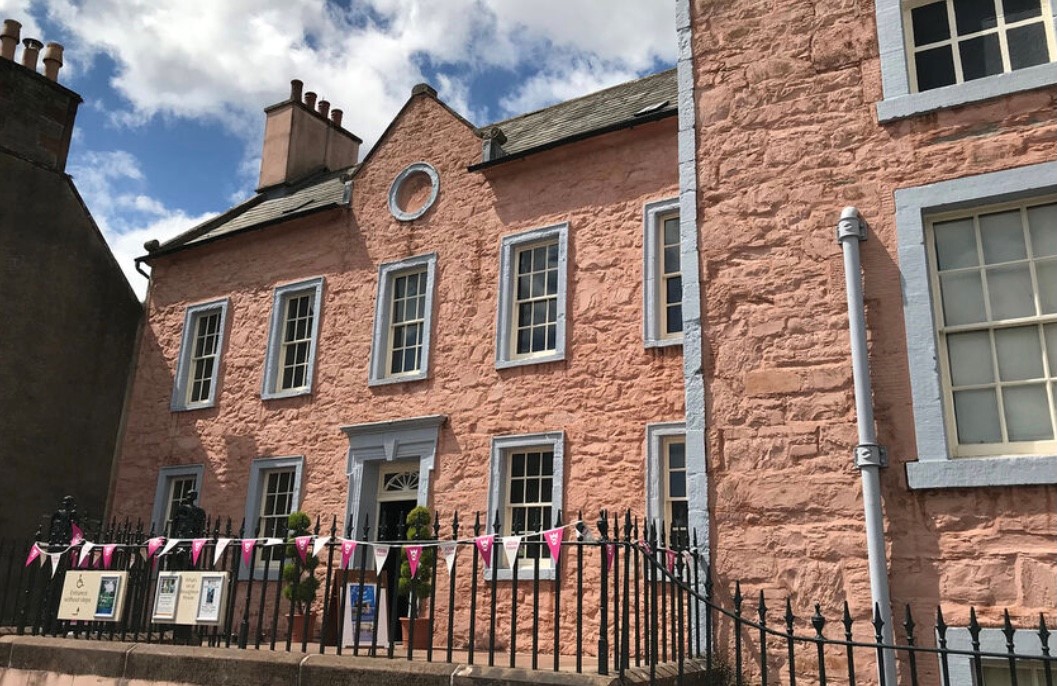 When Hornel died in 1933 he bequeathed the entire house, studio, library, garden, Japanese artefacts, and a substantial endowment to the town he loved. Today Broughton House is now cared for by the National Trust for Scotland and remains the best place in the world to see Hornel’s work in the surroundings for which it was created (open year-round; check seasonal hours).
More than any other single figure, E.A. Hornel turned quiet Kirkcudbright into Scotland’s “Artists’ Town” – and his luminous, joy-filled paintings still make Galloway summers glow on canvas
Jim Bell
January 2026
See also
https://www.kirkcudbrighthistorysociety.org.uk/wp-content/uploads/2024/06/Broughton-House-.pdf