
Andrew Nicholson
Over 70 members and guests of Kirkcudbright History Society were treated to a lively, informative, illustrated talk on the Vikings in Dumfries and Galloway at their first meeting of the winter season.
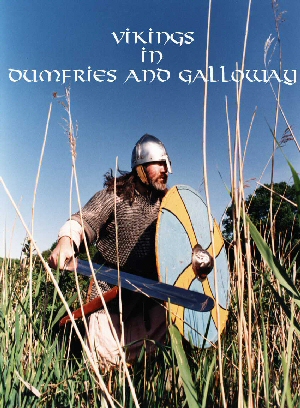
The speaker wearing Viking dress and carrying weapons and implements of the period was “Guthrum Thor Wulfsson”; better known locally as Andrew Nicholson, Historic Environment Record Officer with Dumfries and Galloway Council. Andrew has considerable local knowledge and practical expertise on the Vikings and gave a clear insight into their influence in our region.
Viking warriors from Scandinavia first appear in documented history in the 8th century. Initially they were seafaring raiders. However these raids expanded into campaigns of conquest and ultimately settlement. Dumfries and Galloway has a rich Viking past.
For example place names and geographical features containing the words “dale”, “holm”, “beck”, “ness”, “gyll” indicate Viking settlements. They also suggest where the settlers may have moved from like Yorkshire and East Anglia. Such names are a particular feature of East Dumfrieshire, the Stewartry and around Whithorn.
We are also fortunate to have much evidence from archaeological finds in the region. This includes weaponry, tools, bone and horn implements, skins, leatherwork, knives, pins, jewellery, games and coins. Some of these items show the craft and manufacturing skills like leatherwork and smelting practised locally. Other items like beads, skins and coins are evidence of trading. This took place within the Irish Sea and beyond for example with the North Sea and Baltic Sea.
The Vikings were skilled mariners and navigators and travelled beyond Europe as far as North America and via the Russian river systems, to the Black Sea.
Andrew Nicholson showed the audience replicas of chain mail, weapons, helmets, tools and implements and explained their use. He also gave a fascinating illustrated talk containing pictures of many objects discovered in the region and elsewhere on archaeological digs. This work has enabled historians to build a revealing picture of Viking life and settlement and reconstruct some of its aspects.
It was explained that the Viking warrior’s cloak was often the most valuable item worn because of the rare, prized dyes like indigo used in making it. Also they never wore horns on their helmets!!
The Vikings did not come to the region only to plunder. They came here to settle and intermarried. They brought crafts, farming skills, nautical skills and industry from their homelands. They worked with the church. They also encouraged international trade and brought us into a European context. The whole of the Irish Sea area including Ireland, Wales, England, the Isle of Man and Scotland came under the influence of the Vikings. Our culture in Dumfries and Galloway has benefitted from their presence.