
On the 10th anniversary of its discovery, new research and conservation has revealed the West Asian origin of the lidded vessel which contained many of the unique treasures that comprise the Viking-age Galloway Hoard, and which will go on public display for the first time later this month.
On its discovery, the vessel was found wrapped in textiles which in themselves are an extremely rare survival from the burial of the Hoard,  around AD900, in Galloway in the southwest of Scotland. Those textiles have been carefully studied and retained for further analysis with as much as possible preserved in situ on the vessel. This delicate balance of careful conservation work and research has revealed the intricately decorated surface of the vessel for the first time since it was put in the ground over 1000 years ago.
Where the surface of the vessel had previously only been viewed through x-ray scans, laser cleaning has helped to reveal further details of the design, including crowns, fire altars, leopards and tigers. This remarkable imagery is unusual in western Europe and suggested an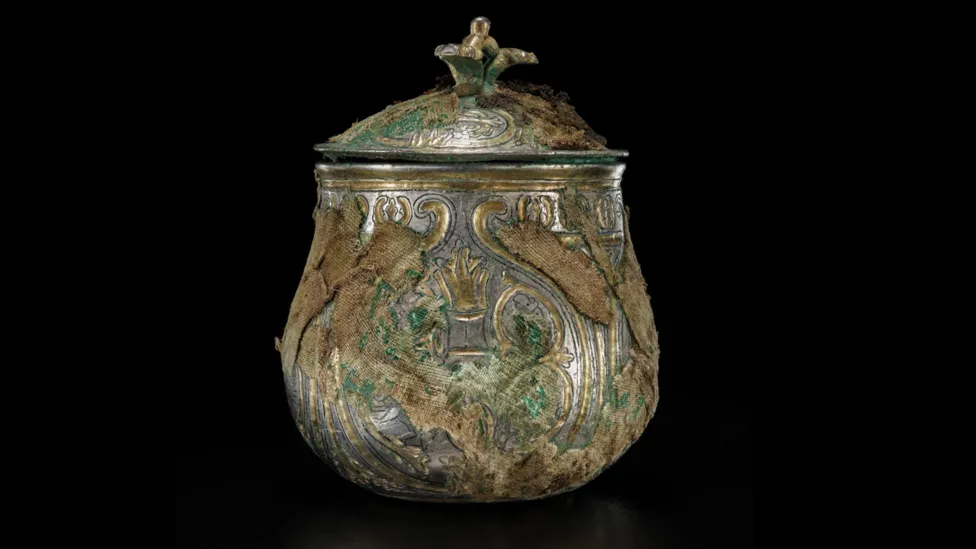 association with the iconography of Zoroastrianism, the state religion of the Sasanian Empire, the last Iranian empire before the early Muslim conquests of the 7th–8th centuries AD. New scientific analysis has confirmed that materials used to make the vessel originated in what is now central Iran.
The Galloway Hoard contains the richest collection of rare and unique Viking-age objects ever found in Britain or Ireland. Buried around the end of the 9th century, the Hoard brings together a stunning variety of objects and materials in one discovery. It was discovered on 1st September 2014 by metal detectorists and excavated by the Dumfries and Galloway Council archaeologist.
It was acquired by National Museums Scotland in 2017 with the support of the National Heritage Memorial Fund, Art Fund and the Scottish Government as well as a major public fundraising campaign. Since then, it has been undergoing extensive conservation and research at the National Museums Collection Centre in Edinburgh under the auspices of an AHRC-funded research project, Unwrapping the Galloway Hoard, undertaken in partnership with the University of Glasgow.
While little can be said with certainty about who buried the Galloway Hoard and why, several discoveries from the conservation and research work have offered tantalising hints of the deeper history behind this collection, which probably accumulated over several centuries. These include a Christian pectoral cross depicting symbols of the four evangelists, the runic inscription of the name ‘Egbert’ on a silver arm ring, and the revelation of a spectacular rock crystal jar decorated with gold filigree bearing the words ‘Bishop Hyguald had me made’. Along with the West Asian origin of the vessel, the many unusual objects in the Galloway Hoard take us well beyond the usual stereotype of Viking raiders. This Hoard tells us a richer story about complex interactions with neighbours and newcomers, connections with previous generations and the rest of the known world.
The original vessel will go on display for the first time later this month as part of the British Museum’s forthcoming exhibition, Silk Roads (26 Sep 2024 to 23 Feb 2025).
An online event, Galloway Hoard: A Decade of Discovery, hosted by Sally Magnusson and featuring several members of the research team, will be held on 11 September, showcasing some of the remarkable discoveries made to date.
The Galloway Hoard will eventually go on long-term display at the National Museum of Scotland in Edinburgh with a significant and representative portion of it also displayed long-term at Kirkcudbright Galleries.