

Jougs
Following concern, shown here, about the state of the jougs at the Tolbooth, a local smith has restored them. It is to be hoped they last for some time in the future. He was tasked with creating replicas which were placed outside the tolbooth with the originals placed in the collection for protection.


Curfew
The reason for the curfew not being rung at present is also being looked into. Further to this, a query was made to us about the timing of the Tolbooth curfew and the reason why it rang. We believe it rang every evening at 6.00pm and once a month at 7.30 for the Council Meeting.
Many people who grew up in that area of High St. remembered it being 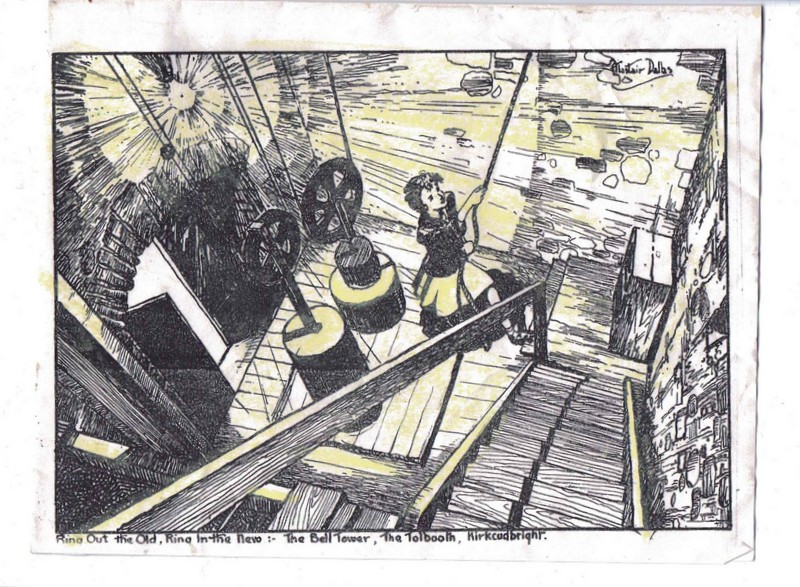 rung. Two being here by Felicity Gelder and Moira Jones, both being interviewed by Tania Gardener. https://collections.ed.ac.uk/eerc/record/165116/archival_object
https://collections.ed.ac.uk/eerc/record/165114/archival_object
It was a great treat for children to be allowed to ring the bells. Previous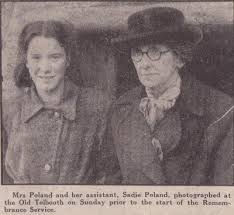 to William Davidson, Mrs Poland rang the Curfew bell.
As to the reasons why it was wrung, these vary as to whether it was closing the town gates, shutting house doors or putting out the fires “couvre feu”
The word “curfew” comes from the Ole French phrase “couvre-feu“, which means “cover fire”. It was later adopted into Middle English as “curfeu”, which later became the modern “curfew”.
Its original meaning refers to a law by that all lights and fires should be covered to extinction at the ringing of an eight o’clock bell to prevent the spread of destructive fire within communities in timber buildings. With the same derivation a “curfew” also refers to a device used to cover the embers of a fire at night, allowing it to be re-ignited more easily in the morning.
In the last few decades, the curfew bell in the Tolbooth has rung on a time switch at 6pm. As far as we know, the only curfew bells still rung in Scotland are in the Tolbooths of Kirkcudbright and Crail. We hope the ringing of the bell can be reinstated soon; it would be a loss if not.
Two additional pieces of History linked to Kirkcudbright Tolbooth are:
From his website https://www.old-kirkcudbright.net/extracts-articles/newspapers/fairs/ Jim Bell has sent us this reference to the curfew.
Re Curfew bell. Seemingly it was rung to start the “watch and ward”
The small customs were let for £20, 10s 4d, and the burghers had also to pay “scat” for watch or ward, which was the equivalent for our present police assessment. This watch and ward, we learn from the 86th chapter of the Leges Burgorum, was that “forth of ilk house inhabit, ane man sould come to watch for feare of peril, quha sall passé frae dure to dure with ane staff in his hand, and sall be of ane man’s age, and quhen Cerfure (Curfew) is rung in, he sall come forth with twa wapons, and sall watch cairfullie and discrietlie until the morning, and gif he fails therein he sall pay unlaw of four pennies.”
https://www.old-kirkcudbright.net/extracts-articles/newspapers/fairs/
From Dr David Devereux:
The curfew bell seems to have had a number of signalling functions at different times. I suspect the same bell was also used to announce the imminent start of the Burgh Court sessions in the Tolbooth. I remember a case in the Burgh Court records, where an individual who had been summoned but did not appear, made his excuse that he had been up the Barhill and had not heard the bell ring! I wonder how many people used that one.