
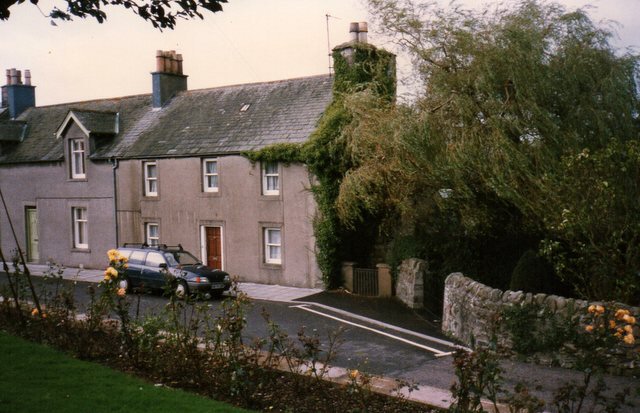
The 20016/17 programme for Kirkcudbright History Society finished with a talk by Vivien Dania on the history of 31 St Mary’s Place, Kirkcudbright. A borrowed book from the library gave Vivien the inspiration to research the development of the house and the people who had lived there. The title deeds showed the house had been built in the early 1850s but there are documents from 1808.
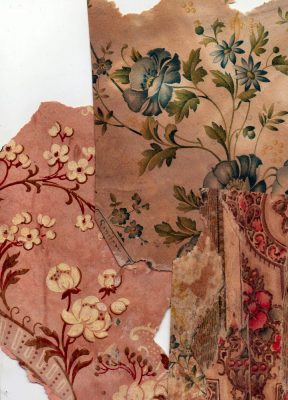
When Vivien and her husband, Carl, moved into the house in December 1996, they found a rotten skirting board and on trying to fix it, uncovered a fireplace thought to date around 1850. Four layers of wallpaper on the staircase were found one of which had been treated with a thin oil which enabled it to be wiped clean and was marketed at the time (around 1920’s) as ‘sanitary’.
Dalbeattie brick was discovered in an interior wall but as this type of brick had a reputation for being soft, Vivien and Carl decided to leave well alone and re-plaster over it. Nothing in the house is standard build and it has a selection of Georgian doors and sash windows with the original glass in them. The house was built as a weaver’s cottage and shop by Peter Gourlay and on the gable wall there are signs of two fireplaces, one bricked up and the other filled by stone.
In 1792 Kirkcudbright Cotton Manufacturing Company existed and between 1828 and 1838 there were 60 looms in the town. The house was built as a weaver’s cottage and shop by Peter Gourlay and on the gable wall there are signs of two fireplaces, one bricked up and the other filled by stone. The reasons for these remains a mystery.
One of the many inhabitants of the house, who Vivien has researched, was Peter Gourlay. The 1819 census lists Peter Gourlay, Weaver, living in the house with his 7 children. His son, also called Peter, was involved in a curious court case regarding the ownership of a pony called Billy Button Brown Pony, together with items of tack. The pony and tack were purchased from David Blair of Borgue but Burgh Records show that the case had claim and counter claim between 1832 and 1833. Mr Blair was incarcerated in the Tolbooth in 1834 for non payment of expenses to Peter Gourlay. However, a day later Peter authorised the magistrates to liberate David Blair. Unfortunately, there are no further details of the case. In 1850 Peter Gourlay died and in his will he left £415.21 which equates to around £39,000 today. One of Peter’s daughters, Grace, married John Kissock Grier, who was born in Kirkcudbright in 1815. John first went to sea in 1830 as an apprentice on the ship Aracan bound for Shanghai.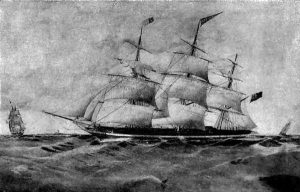
By the age of 27 he had been promoted to Second Mate. After his marriage they moved to the Isle of Man where John was a Captain for the Isle of Man Steam Packet Company but they eventually returned to Kirkcudbright.
More recent records show the house being owned by Henrietta Wallace, wife of Walter Wallace. She was proprietor of not only number 31 but also 27 and 29 Townend from 1903 until her death in 1931. The property was then held in trust until 1975.
The house was vacant for two years before Vivien and Carl bought it and photographs showing the garden as it is now is a testament to the hard work they have carried out in turning it into their own little corner of the town.

Further details about the Society and future events in the Stewartry can be found on the website www.kirkcudbrighthistorysociety.org.uk