
At the Society’s meeting of February 2019 Dr David Devereux gave an update on the previous seasons excavations looking for the the specific location of Tongland Abbey, founded for the Premonstratensian order of canons by Alan, Lord of Galloway, in 1218. The first canons to occupy the abbey came from Cockersand Abbey on the Lancashire coast. David explained that the purpose of the archaeological dig that has been taking place over the last three years was not to undertake a detailed excavation of the whole reputed abbey site, but to open up a series of trial trenches in carefully targeted areas that would help to identify the location of the main abbey complex and give some idea of its probable layout. Excellent illustrations were provided of all the various maps that gave clues to the positions of the anticipated buildings, and floor plans of abbeys of similar scale, such as Dryburgh and Glenluce, were overlaid to give an impression of how such buildings might relate to the nearby ruins of the two Tongland former parish churches dating from around 1633 and 1813. A fine artist’s impression of how Tongland Abbey might have looked in its prime, prepared by David’s fellow archaeologist John Pickin, made clear how impressive it would have been in both scale and character.
It was explained that the survival of only a tiny portion of a wall reputed to be part of the Abbey, and later forming part of a wall of the old Tongland Church (1633) was unusual, compared for example with the impressive ruins of Dundrennan Abbey. Many buildings of similar antiquity to Tongland Abbey had suffered greatly from being plundered to yield an abundance of good quality dressed stone, and some such stones were evident in many of the buildings, dykes and bridges in the Tongland area. The holes or ‘robber trenches’ that were left after such plundering were back-filled with random rubble, which consequently preserved the alignment of walls, even when the original construction materials had been removed.
An area of land from Tongland village, stretching towards the River Dee, had also been subject to extensive landscaping and altered gradients resulting from the construction of the Galloway Hydro Electric scheme and domestic developments including the formation of tennis courts and gardens. The existence of these confusing features, combined with the fact that much of the land around Tongland Church was consecrated ground, made identifying promising areas in which it was possible to dig, a difficult task. Specialised geophysical investigations were undertaken in 2015, but they provided little useful information due to the fact that much of the later landscaping previously referred to masked what might or might not lie beneath it.
‘One of the wall foundations exposed by archaeological excavation on the site of Tongland Abbey’
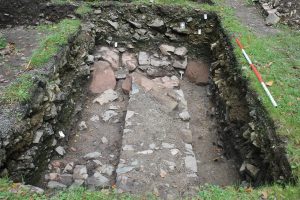 Despite all these limitations and impediments to progress, David’s targeted areas for excavation in the northern part of Mansewood garden, adjacent to the old parish church, revealed a series of foundations, walls, and earlier ground levels, that may possibly form part of the western range of the abbey cloisters. The excavations undertaken in 2018 followed the walls first found in 2017 in an effort to determine where they might begin, end, change direction, or simply disappear. The foundations and wall fragments that were found vary greatly both in scale and in the quality of the stonework, but the largest and grandest of them are what might be expected beneath possible abbey buildings of the period. Fragments of a gilded copper-alloy belt chape, part of a small bell possibly attached to horse-harness and sherds of medieval pottery have also been found which add greatly to the thrill of the chase.
Thanks to the generous help and cooperation of the owner of Mansewood (the former Tongland Manse), it is planned to continue excavation work in 2019. The knowledge, tenacity, optimism, imagination and determination of David and his team of volunteers will hopefully be further rewarded in the coming season. Their efforts are already shedding much-needed light on a mystery which has lurked in the shadows for several hundred years.
D.R.Collin. 14/2/2019