
We are grateful to Simon Halstead, crew member at Kirkcudbright RNLI for contributing this piece of research into the mystery surrounding Priscilla Mac bean.
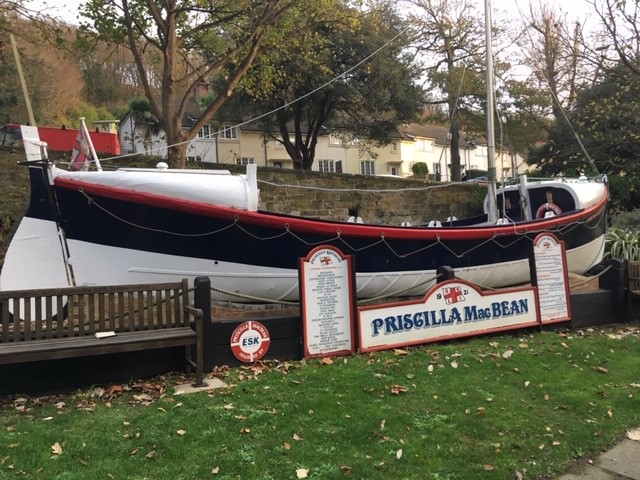
The “Priscilla MacBean” is important as she was the first motor lifeboat to be launched from a beach, having been designed and built for both motor and ‘sail and oars’.
Built in 1921 at J Samuel Whites in Cowes she was originally intended for service at Eastbourne and on more than one occasion was launched on service in conjunction with the Hastings Lifeboat. The boat is of the style and era of the “Mary Stamford” lost in Rye Bay in 1928 which was a pulling and sailing lifeboat without a motor. However she was not considered suitable for the English Channel and in 1928 she was moved to Kirkcudbright in Scotland to cover the area of the Solway Firth. A few years later she was moved across the Solway Firth to Maryport in Cumbria to continue her service in saving life and finally was retired from RNLI service in 1934.
Until this boat was built, all motor lifeboats had been of a size and weight which made it essential either to use a slipway for launching, or to keep the boat at moorings. As the foreshore at Eastbourne made these methods impossible to implement, the committee of management decided, as a result of representations from the Eastbourne committee, to design a new type of motor lifeboat, light enough to be launched from a carriage. This boat was built simply as an experiment, but before the inaugural ceremony took place, she had justified herself sufficiently to cause the institution to lay down the keel of a similar Boat for Scarborough.
The Eastbourne Boat was of the self-righting type, 35 ft. by 8 ft. 6 inches, and was fitted with an auxiliary engine of 15 h.p. The total weight of the boat and engine was less than 6 tons, as compared with over 9 tons, which was the weight of the next lightest type. She had a speed of 6 knots and a radius of action of 80 miles.
The greater part of the cost of this boat was defrayed by a legacy received from the late Mr. Edward Macbean, of Helensburgh and Glasgow.
She served 3 years as Kirkcudbright lifeboat. She was replaced by the “Morison Watson”. The crew on that first voyage to Kirkcudbright were Coxswain George Parkhill, Bowman ex Provost W.MacKenzie, Artist William Robson and John (Hubby) Poland.”
She was Kirkcudbright’s 5th Lifeboat and was the first one with an engine.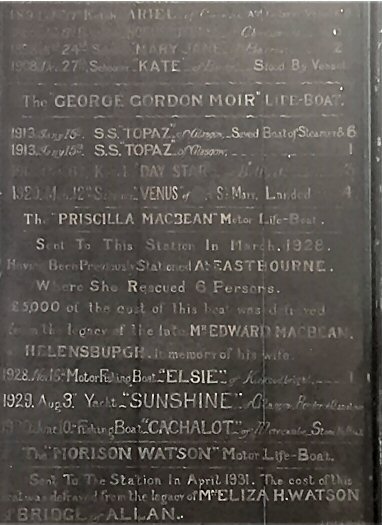
In Feb 1928 the Kirkcudbright crew headed to Maryport to pick her up. This involved rowing the pulling and sailing craft “George Gordon Moir” across the Solway Firth but as the weather was foggy, with headwinds and high seas they turned back after eleven hours. On the next day at 0130 they set off again and after sixteen hours arrived in Maryport. An overnight stay was necessary, after which they returned to Kirkcudbright, Thanks to the engine, the return crossing of the Solway Firth took only 3 hours.
The subsequent history of the “Priscilla MacBean” is somewhat chequered but she is known to have been used in France for leisure for two years then brought back to England where she operated as a pleasure boat on Lake Windermere. After some years as a houseboat she was bought by someone in Eastbourne with a view to operating her as a pleasure boat in the English Channel off Eastbourne but sadly this idea did not get off the ground.
In 2013 Old Towner ‘D-Day White’ spotted the hull of the old lifeboat laying in a field in Hailsham Sussex, he was intrigued and when he discovered it was to be left to rot was determined to recover the boat if at all possible. Together with Tush Hamilton he purchased the hulk and she was then moved to the East Hastings Sea Angling Association for her restoration to begin. She is now fully restored and on display in Hastings.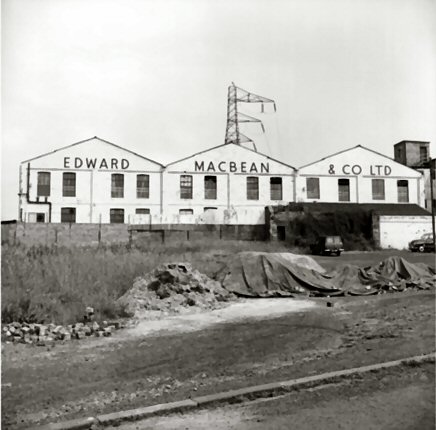
The photo above shows the main frontage of the MacBean factory from the west. This was completed by 1906. The main requirement for the class of manufacture undertaken here was a large floor area for the application of waterproofing material and its subsequent drying. In the 1880s there was a steady demand for tarpaulins to cover open railway wagons and goods being transported on horse-drawn lorries. There was also a growing market for waterproof clothing for fishermen and other seamen.
As can be seen below Edward MacBean married Priscilla H W Stewart in 1869 in Glasgow, there is a local connection because Priscilla was born in Sanquhar in 1830. Her father James Stewart and grandfather also James Stewart were all born in Sanquhar.